A film by Growv · 41 seconds · 2026
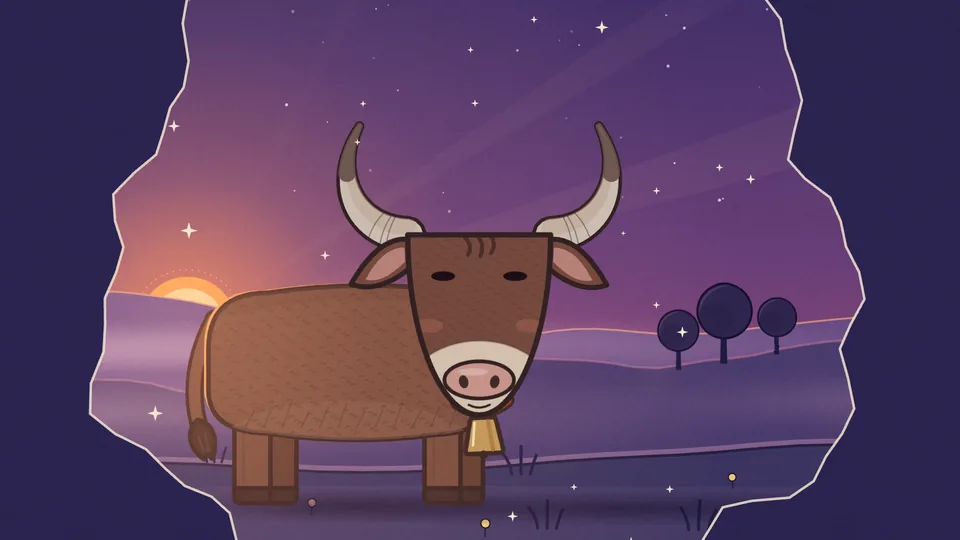
A was an ox.
Almost 4,000 years ago, a miner in the Sinai drew an ox’s head to write a sound. You still write it every day – upside down. This is its life story in forty-one seconds, without a single cut.
0:41 · headphones recommended
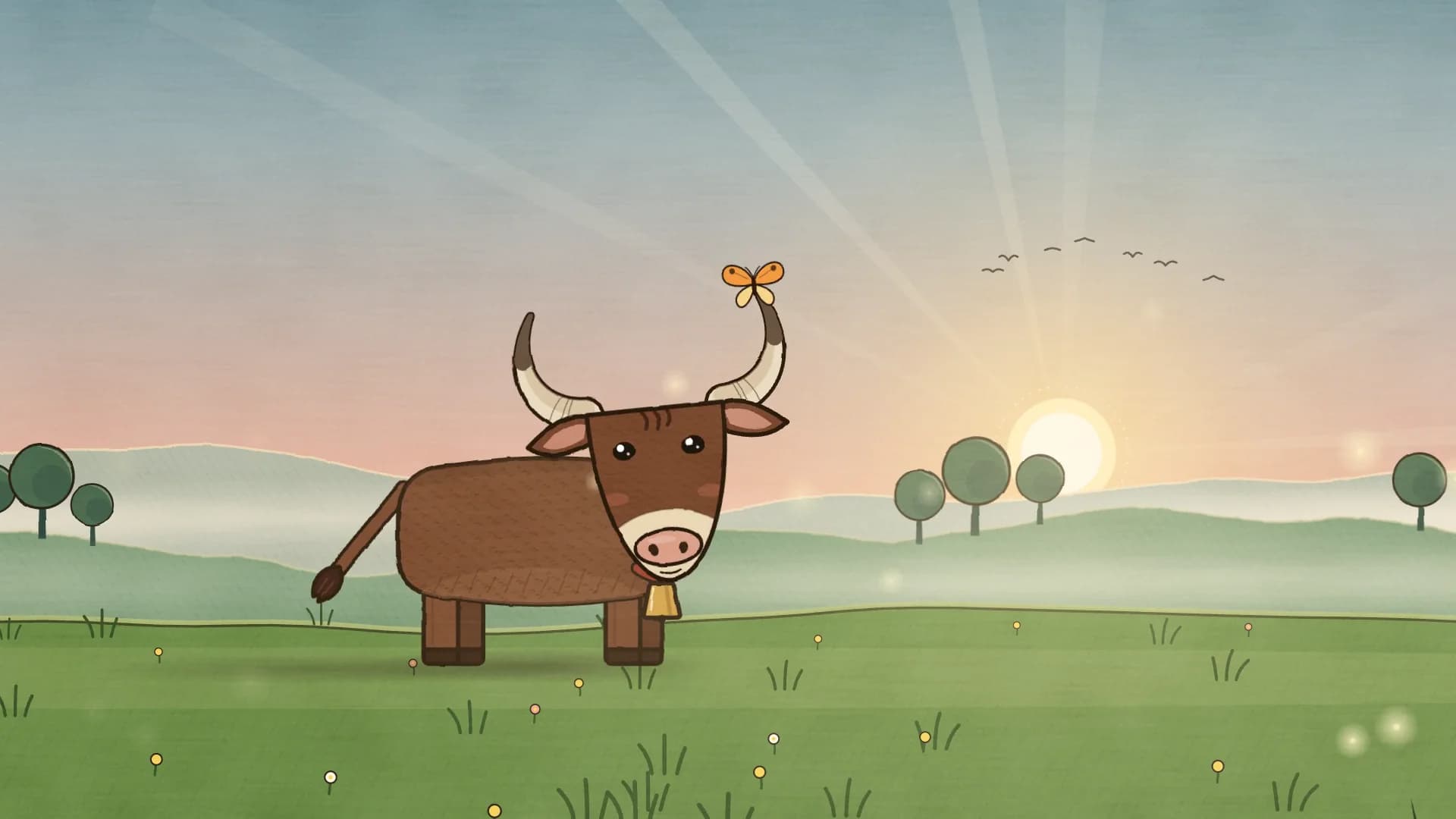
- Dawn, 0:00: An ox grazes in a meadow at dawn. It turns to face us, we move in on its face, and the face turns to stone.
- Sinai, 0:05: An ox’s head is chiselled into a sandstone mine wall: a face and two horns. The sign rolls onto its side…
- Byblos, 0:08: …and is painted on the sail of a Phoenician ship at sea.
- Greece, 0:12: On a black-figure Greek vase the letter stands upright: alpha.
- Rome, 0:15: It is cut into marble as a Roman capital A and painted red; a column’s spiral unrolls into a scroll.
- Aachen, 0:19: On a manuscript page an initial A grows gold and vines, and a quill writes the small a.
- Mainz, 0:22: Mirrored lead type is inked, the press comes down, and a page is printed.
- New York, 0:25: The page rolls into a typewriter, which types “a was an ox.”
- Switzerland, 0:28: The carriage whips across to a red Swiss poster with a huge black a; we dive into one of its halftone dots.
- 8 × 8, 0:30: The dot lights up a green computer screen: an a made of pixels.
- Now, 0:33: The pixels smooth into a phone. A thumb taps A, and the A flips upside down.
- Dusk, 0:36: The upside-down A grows horns and eyes: it is the ox again, in its meadow at dusk, under the title “A was an ox.”
The fact
Turn any A upside down. The horns are still there.
Around 1850 BCE, workers at the Egyptian turquoise mines of Serabit el-Khadim, in the Sinai, borrowed pictures to write their own language. For the first sound of alp – “ox” – they drew an ox’s head: a face and two horns. Phoenician sailors laid it on its side. The Greeks stood it on its point and called it alpha. Every A since is that ox, turned over.
- Leg
- what it stands on
- Crossbar
- across the middle
- Counter
- the space inside
- Apex
- the point on top
The ten lives of A
Carved, carried, turned, chiselled, written, cast, struck, set, lit – and tapped.
Carved in stone
Sinai
Miners at Serabit el-Khadim write alp, ‘ox’, as an ox’s head.
Carried by sailors
Byblos
Phoenician traders lay it on its side, call it aleph, and carry it round the Mediterranean.
Turned upright
Greece
Greek has no use for its throat sound, so it becomes a vowel – alpha – and stands on its point.
Chiselled in marble
Rome
The inscription on Trajan’s Column: capitals that type designers still trace.
Written by hand
Aachen
Charlemagne’s scribes settle on a small, round hand – the ancestor of the lowercase a.
Cast in lead
Mainz
Gutenberg casts every a backwards in lead, so it prints the right way round.
Struck by keys
New York
The first typewriter to sell well puts the a under your left little finger. It’s still there.
Set on a grid
Switzerland
Swiss designers strip it down to its plainest, most neutral form.
Lit in pixels
8 × 8
On a home computer an a is eight bytes: a grid of glowing dots.
Tapped by you
Now
You type it thousands of times a day. Turn it over and it’s an ox again.
Every frame
1,230 frames. Not one cut.
Every scene turns into the next – an ox’s face into stone, a sail into a vase, a column into a scroll, a halftone dot into a screen. Tap any frame to play from there.
The making
Drawn, animated and scored entirely in code.
No camera, no stock, no generated video. Every frame is a React component rendered with Remotion, and every letter is a real outline – traced from type or drawn point by point – that morphs into the next. The score is synthesised in Python: a lyre, frame drums, Roman brass, a choir, a printing press, a typewriter, a chiptune and a synth, all built around the note A.
- Running time
- 41 s
- Frames
- 1,230
- Scenes
- 12
- Letterforms
- 10
- Synthesised sounds
- 38
- Samples
- 0
- Cuts
- 0
- Direction & design
- Growv
- Animation, code & score
- Built with Claude
- Engine
- Remotion
- Type in the film
- Cinzel, UnifrakturMaguntia, Courier Prime, Inter, Instrument Serif
A was an ox. It still is.